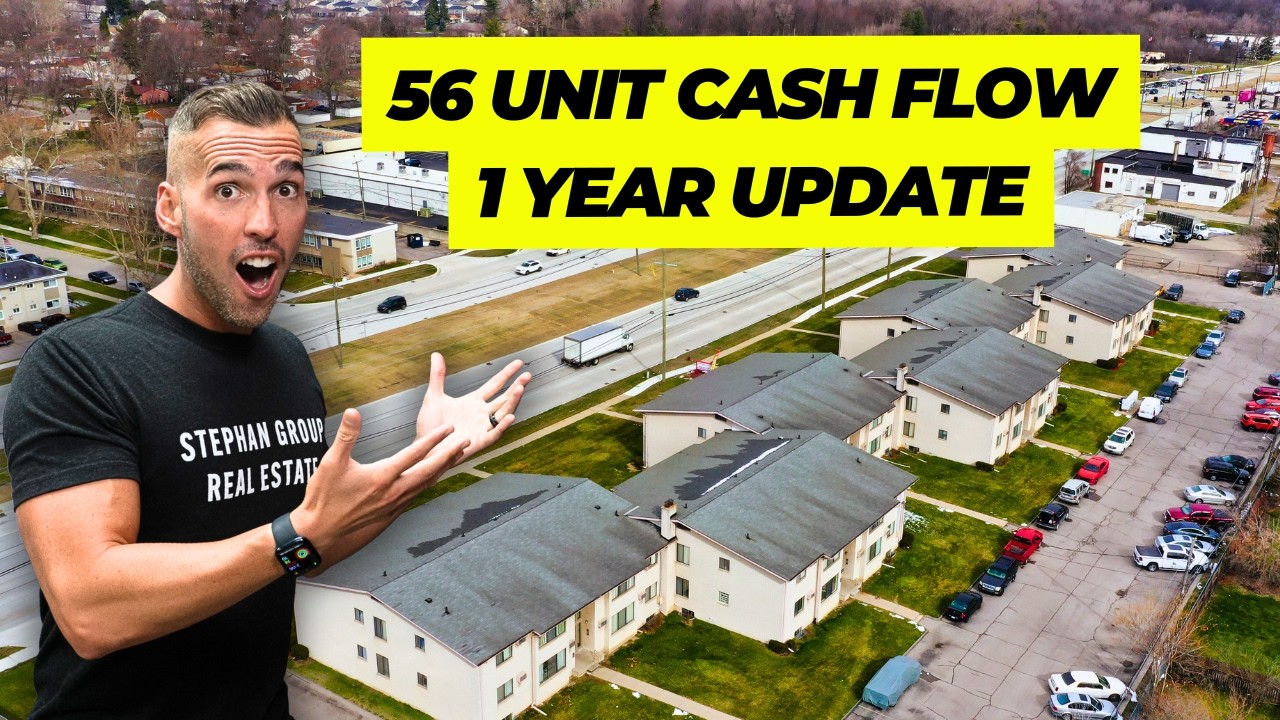
Small multifamily investing is full of myths that keep good people stuck, broke, or out of the game entirely. I know, because I hear them in my comments and from my clients every week. Meanwhile, my wife and I own a 56-unit apartment we bought for $5 million in 2023, now appraised at $7.1 million, that pays us about $134,000 a year. The difference between people who get results and people who do not usually comes down to which myths they believe. Here are the ones costing you the most, and the truth from a building I actually own.
Myth 1: “My duplex makes more”
I get this comment constantly. Someone with a duplex insists their small property out-earns my apartments. It does not.
Over a full 12 months, my 56-unit produced $799,844.82 in income and $134,270.01 in net cash flow after everything. No duplex does that. The reason people believe this myth is they compare a cherry-picked month or a per-unit figure instead of the full annual picture.
The fix is simple: look at the trailing 12-month numbers, not a snapshot.
Myth 2: You can judge a deal on one month
This is the same error in a different costume. People take one month’s profit and loss statement and treat it like the truth.
One month is one blood-pressure reading. Everyone has a great month and a terrible month. You learn the real health of a multifamily business by reading the trailing 12-month P&L. That is where you see the $117,973.37 tax bill, the $53,422.67 of capital expenditures, and the seasonal landscape and snow costs that a single month would hide.
I broke a real one down line by line here: how I read a full-year P&L. [internal link: anchor “how I read a full-year P&L” → Post 2 / BRRRR strategy multifamily T12 breakdown]
Myth 3: It is all about raising rent
If you think multifamily success is just jacking up rents, you are leaving roughly half the potential on the table.
When I bought my building, the prior owner was generating about $450,000 in gross income and ignoring entire revenue streams. I pushed it toward $800,000 using three levers, not one:
- Rent. Yes, I raise it.
- Other / ancillary income. Revenue sources the previous owner never touched.
- RUBS. Ratio Utility Billing System, billing utilities back to residents instead of absorbing the cost.
For background on the billing method, see how RUBS utility billing works. [external link: anchor “how RUBS utility billing works” → a property-management or utility authority source]
Real owners and operators chase all three. Rent alone is the lazy half of the equation.
Myth 4: CapEx and repairs are the same thing
This one quietly destroys people’s underwriting. When I review deals with clients, unsophisticated owners constantly bury capital expenditures inside repairs and maintenance.
A new water heater, new windows, new cabinets, new flooring, those are CapEx, one-time investments in the asset. They are not R&M. On my building, R&M and cleaning ran $30,965.66, while CapEx ran a separate $53,422.67. Mixing them makes a property look more profitable than it is and leads you to overpay.
Here is why that mistake is so expensive. When a seller buries CapEx inside repairs and maintenance, their expenses look higher and their NOI looks lower than reality, which can hide a deal’s true value, or the reverse: a buyer who does not split the two correctly will underwrite a property as if a $53,000 one-time spend repeats every single year, and either walks from a good deal or pays the wrong price on a bad one. Get the classification wrong and every downstream number, NOI, cap rate, valuation, and cash-on-cash, is wrong with it. This is the single most common error I catch when I underwrite alongside clients.
Worse, plenty of owners try to minimize CapEx to take home more cash. I do the opposite. I let the cash flow upgrade the asset, because if you take care of the building, it takes care of you.
Myth 5: Raising rent is wrong, and small properties are worth holding forever
A lot of investors feel guilty raising rent and get emotionally attached to their small properties. Both feelings cost money.
Look at my tax bill. The prior owner paid about $40,000 a year in taxes. I now pay $117,973.37. That increase does not come out of my pocket, it has to come from the property’s income, or the bank would not have done the deal. As your expenses climb, your income upside has to climb too. That is not greed, it is how the business survives.
And the attachment problem: people tell me they have duplexes and fourplexes they “cannot let go of.” Those small properties will never make what an apartment building makes. The way you grow is to 1031 exchange out of them and trade up, exactly how I got from a few two-units and a fourplex into 56 units.
See the IRS rules first: how a 1031 exchange defers tax. [external link: confirm/replace target → IRS Like-Kind Exchanges]
Myth 6: You can do this with no money down
I will be blunt: this is not a no-money-down game.
I do not teach hard-money, “I have no money” deals. To do this at a real level, you need capital on hand, in my world a couple hundred grand, and ideally you are a high-income earner ready to invest. The people selling you a no-money-down apartment fantasy are not buying $5 million buildings with their own capital and pulling out seven figures.
That does not mean you cannot start. It means you start honestly, save and build, and climb the ladder. The investors who actually make it in this space treat their capital as a tool they earned, not a shortcut they avoided. When someone tells me they want in with nothing down, what they usually need first is to get their income and savings to the point where a real deal is even possible. That is not a discouraging answer, it is the honest one, and it is the same path I walked before I ever bought a $5 million building.
So, is small multifamily investing worth it?
Here is my answer, with real numbers.
I bought a $5 million asset. I took a roughly $1 million depreciation write-off through cost segregation and used it against my earned income. The building is now worth $7.1 million thanks to the BRRRR method. I refinanced from 7.5% down to 6.2% and pulled out $1,010,000 in tax-free equity, more than I originally put down. The building still pays me about $134,000 a year, and I still get depreciation every year.
Because I have none of my own money left in the deal, my return is infinite. I did not get lucky and I did nothing magical. I bought a building and ran it better than the last owner. The money is made in the management and the operations.
So yes, it is worth it, if you avoid the myths, look at the full picture, and treat it like the business it is.
Stop believing these small multifamily investing myths
If any of these small multifamily investing myths have been holding you back, the fix is the same one every time: get honest with the math and learn the operations. None of what I did was luck. I bought a building, classified the numbers correctly, pulled the three income levers, and reinvested the cash flow. The myths are what keep people from doing the same thing.
Grab my book on the method [internal link: anchor “my book on the method” → The Small Multifamily BRRRR Method], and when you want to buy an actual building with help, apply for the mentorship [internal link: anchor “apply for the mentorship” → Mentorship application].
The truth does not get rich-quick, but it does get rich. Avoid the myths, do the work, and let the asset pay you.
Frequently asked questions
Is small multifamily investing worth it?
Yes, if you treat it like a business. My 56-unit, bought at $5 million and now appraised at $7.1 million, pays about $134,000 a year, returned over a million dollars tax-free in a refinance, and still generates depreciation. Because none of my own money is left in the deal, the return is effectively infinite. The wealth comes from disciplined management and operations, not luck or hype.
Does a duplex really make less than an apartment building?
Yes. Over a full 12 months, my 56-unit produced $799,844.82 in income and $134,270.01 in net cash flow, figures a duplex cannot match. People believe otherwise because they compare a single good month or a per-unit number instead of the full annual trailing 12-month picture. Look at a complete year before deciding which property earns more.
What is the difference between CapEx and repairs and maintenance?
Repairs and maintenance are recurring upkeep, like fixing and cleaning. CapEx, capital expenditures, are one-time investments in the asset, such as new windows, flooring, cabinets, or a water heater. On my building R&M ran $30,965.66 while CapEx was a separate $53,422.67. Burying CapEx inside R&M makes a deal look more profitable than it is and leads to overpaying.
Can you invest in multifamily with no money down?
Not realistically at this level. I do not teach no-money-down or hard-money deals. To buy a building like my 56-unit, you need real capital, in my world a couple hundred grand on hand, ideally as a high-income earner. If you are not there yet, start smaller and trade up through 1031 exchanges rather than chasing a no-money-down fantasy.
Is it wrong to raise rents on tenants?
Raising rents is how the business stays solvent. My property taxes alone jumped from about $40,000 under the prior owner to $117,973.37. That cost has to be covered by the property’s income, not my pocket, or the deal does not work. Responsible rent increases, paired with added revenue and controlled expenses, are simply how a multifamily business survives rising costs.