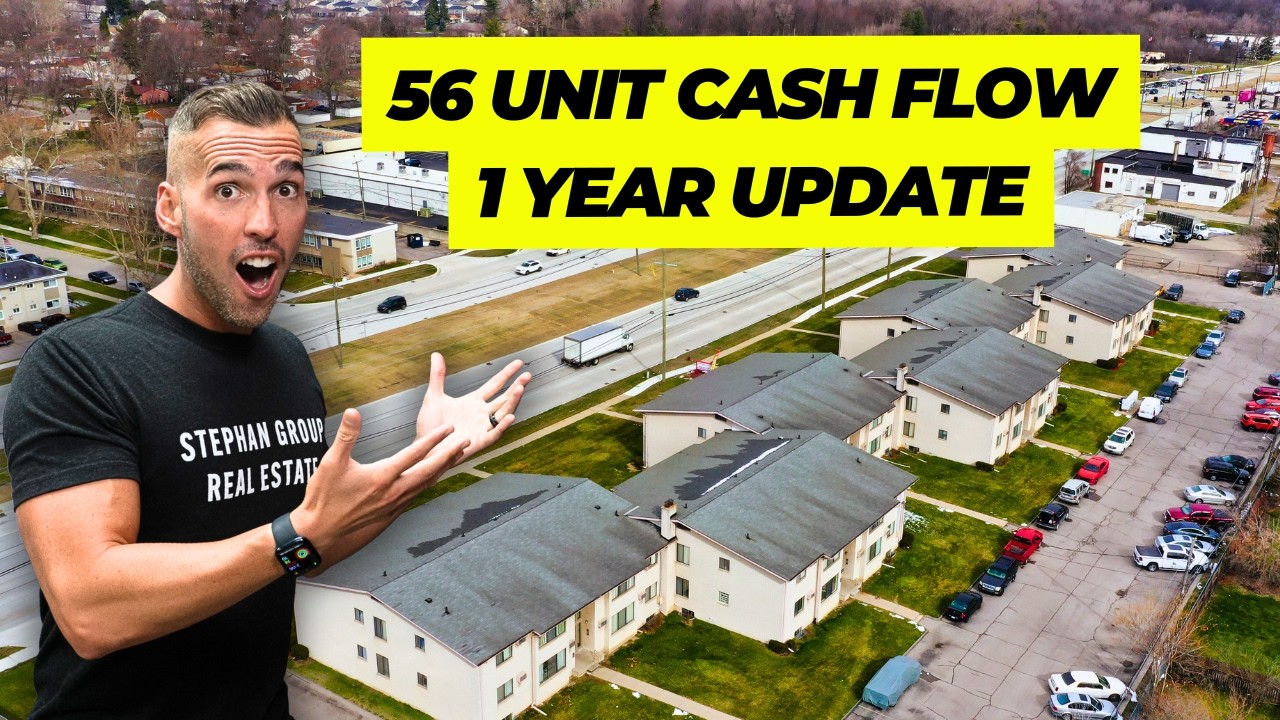
The BRRRR strategy multifamily approach is the single best tool I have for building wealth, and I am going to prove it with real numbers from one of my buildings. I bought a 56-unit apartment in 2023 for $5 million, forced the value up, and in 2026 it appraised for $7.1 million. Over the trailing 12 months it produced $799,844.82 in income and $134,270.01 in net cash flow after everything, including debt service and capital expenditures. Below is the full trailing-12-month profit and loss statement, the refinance math, and how I got my return on investment to infinite.
What BRRRR means in multifamily
BRRRR stands for buy, renovate, rent, refinance, repeat. In multifamily it works like this:
- Buy it right. Get into a deal where there is room to add value.
- Renovate and improve. Light value-add, not heavy construction.
- Rent it up and raise income. Push rents, add revenue, control expenses.
- Refinance. Once the value is forced up, pull your capital back out.
- Repeat. Recycle that capital into the next deal.
For the origin of the method, see this BRRRR overview. [external link: confirm/replace target → BiggerPockets BRRRR overview]
I did not do heavy construction here. The biggest physical item was redoing all the roofs in 2024. The real lift came from operations.
The income: the three levers most owners ignore
Over the trailing 12 months, this building produced $799,844.82 in income. When I bought it, the previous owner was generating roughly $450,000 in gross income. I nearly doubled the top line without rebuilding the place.
If you think success in multifamily is just raising rent, you are leaving about half the potential on the table. I pull three levers:
- Rent. The obvious one, and yes, I raise it.
- Other / ancillary income. Additional revenue sources the prior owner ignored entirely.
- RUBS. Ratio Utility Billing System, where you bill utilities back to residents instead of eating the cost. The former owner was doing none of this.
This is the part of the BRRRR strategy multifamily owners underestimate. Anyone can raise a rent roll. The operators who actually build wealth go after the other two levers at the same time, because every dollar of new ancillary income or recovered utility cost flows straight to NOI, and NOI is what the appraiser capitalizes into value. The previous owner left all of it on the table, which is exactly why there was room to nearly double the top line without touching the building’s bones.
That is value-add apartment investing in practice. You are not hoping the market saves you. You are creating the value through management.
The trailing 12-month P&L (T12)
A single month tells you nothing. Everyone has a good month and a bad month. The way you read the real health of a multifamily business is the trailing 12-month profit and loss statement, the T12. Here is the actual one, to the cent.
Income: $799,844.82
Operating and other expenses:
| Line item | 12-month amount |
|---|---|
| Admin | $522.00 |
| Advertising | $1,734.00 |
| Insurance (bundle policy, Travelers) | $14,081.00 |
| Landscape | $7,329.45 |
| Legal (evictions; some billed back) | $7,546.20 |
| Licenses and permits | $112.00 |
| Maintenance payroll (contribution) | $19,004.00 |
| Maintenance supplies | $9,886.41 |
| Mortgage (at 7.5%, some interest-only) | $299,054.00 |
| Pest control | $375.00 |
| Plumbing | $7,705.69 |
| Property manager (contribution) | $45,000.00 |
| Repairs & maintenance (incl. cleaning) | $30,965.66 |
| Snow | $6,430.56 |
| Taxes | $117,973.37 |
| Utilities | $43,489.00 |
| Total expenses | $612,152.14 |
A few notes on these numbers, because the line items are where the lessons live.
- Payroll is a contribution, not a full salary. My maintenance technician makes about $60,000 a year and my property manager makes $85,000 a year. This building only pays a share, $19,004 and $45,000 respectively, because I run a portfolio of 300-plus units and spread those costs across buildings. A duplex cannot do that. Scale makes everything more efficient.
- Insurance is low because of a broker and a bundle. $14,081 for the year on a bundled Travelers policy through a broker. Use a broker.
- Taxes are the painful one. $117,973.37. When I bought the deal, the prior owner was paying about $40,000. As value goes up, taxes follow, which is exactly why your income upside has to be there.
- Landscape and snow could come in-house at scale. Together those run over $13,000 a year. At 500 to 1,000 units, operators start buying their own mowers and snow trucks. I am not big enough yet.
NOI vs cash flow vs CapEx
This is where unsophisticated owners get sloppy, so be precise.
The $612,152.14 above includes my mortgage. That means it is not your net operating income, because NOI excludes debt service. Stripping the mortgage out, this deal’s NOI is roughly $487,000. That NOI is what drove the $7.1 million valuation.
Cash flow is what is left after all expenses, including debt service: principal, interest, taxes, and insurance.
Below cash flow sits CapEx, capital expenditures. These are one-time investments in the asset: unit upgrades, windows, carpets, flooring. This year that was $53,422.67.
A huge mistake I see when I underwrite with clients is owners burying CapEx inside repairs and maintenance. A new water heater, new windows, new cabinets, those are not R&M. They are CapEx. Misclassifying them makes a deal look more profitable than it is.
So the real math:
- Income: $799,844.82
- Less total expenses (incl. mortgage): $612,152.14
- Less CapEx: $53,422.67
- Net cash flow: $134,270.01
I always let the cash flow upgrade the asset. Most people try to minimize CapEx and pocket more. I reinvest into the building, because if you take care of the asset, it takes care of you.
The refinance: where BRRRR pays off
I bought this deal with a 7.5% interest rate and a couple of years of interest-only payments, which kept early cash flow strong. That rate was just a product of the time.
When I refinanced, I dropped to 6.2%, shaving 1.3% off my rate. Here is the magic of BRRRR: because the building’s value had grown to $7.1 million, I borrowed more money, yet my payment barely went up. I had forced the NOI up enough to support a bigger loan at a better rate.
Out of that refinance, I pulled $1,010,000 in tax-free equity, more than I originally put down to buy the deal.
Why my return on investment is infinite
Once I pulled out more than I had invested, my money was no longer in the deal. Zero dollars of my own capital remain.
Return on investment is profit divided by money invested. When your money invested is zero, the return is infinite. The building still pays me about $134,000 a year, I still get depreciation, and the asset keeps appreciating. On top of that, I took a roughly $1 million depreciation write-off through cost segregation and used it against my earned income.
For the federal rules, see IRS guidance on depreciation. [external link: confirm/replace target → IRS Publication 946, depreciation]
That is the full BRRRR loop: buy right, force NOI up through operations, refinance, pull capital out tax-free, and keep the cash flow.
Run your own BRRRR strategy multifamily numbers
If you want to underwrite a deal the way I just did, with a real T12 and an honest split between operating expenses, debt service, and CapEx, do not eyeball it. The BRRRR strategy multifamily playbook only works when the numbers are clean going in.
Get the Deal Analyzer [internal link: anchor “Get the Deal Analyzer” → Deal Analyzer tool] and grab my BRRRR playbook [internal link: anchor “my BRRRR playbook” → The Small Multifamily BRRRR Method].
When you are ready to do this on a real building, that is what we do together in the mentorship. Apply to work with me [internal link: anchor “apply to work with me” → Mentorship application]
Frequently asked questions
How does the BRRRR strategy work in multifamily?
BRRRR in multifamily means buy a building with upside, renovate and improve it, raise income through rents and added revenue, refinance once the value is forced up, then repeat with the recovered capital. On my 56-unit deal I bought at $5 million, pushed income from about $450,000 to nearly $800,000, refinanced at a $7.1 million valuation, and pulled out over a million dollars tax-free.
What is the difference between NOI and cash flow?
Net operating income is income minus operating expenses, excluding debt service and CapEx. It drives your property’s valuation. Cash flow is what remains after all expenses, including the mortgage. On my building, NOI supported the $7.1 million appraisal, while cash flow after debt service and $53,422.67 of CapEx came to $134,270.01 for the year.
Why should I track a trailing 12-month P&L?
A single month is misleading, since everyone has good and bad months. The trailing 12-month P&L, or T12, shows the true health of the business across a full year of seasonal swings and one-off costs. I read every deal off the T12, which is how I caught my real expense load, like $117,973.37 in taxes and $43,489 in utilities, instead of guessing from one month.
How did you pull money out tax-free?
Forcing the value from $5 million to $7.1 million through the BRRRR strategy let me refinance into a larger loan at a better rate, 6.2% down from 7.5%, with my payment barely changing. A cash-out refinance returns equity as loan proceeds, not income, so the $1,010,000 came back tax-free. That is the core wealth mechanic of BRRRR in multifamily.
What makes a return on investment “infinite”?
Return on investment is profit divided by the cash you have invested. When a cash-out refinance returns more than you originally put in, your remaining invested capital is zero, so the math produces an infinite return. My 56-unit still pays roughly $134,000 a year with none of my own money left in the deal.