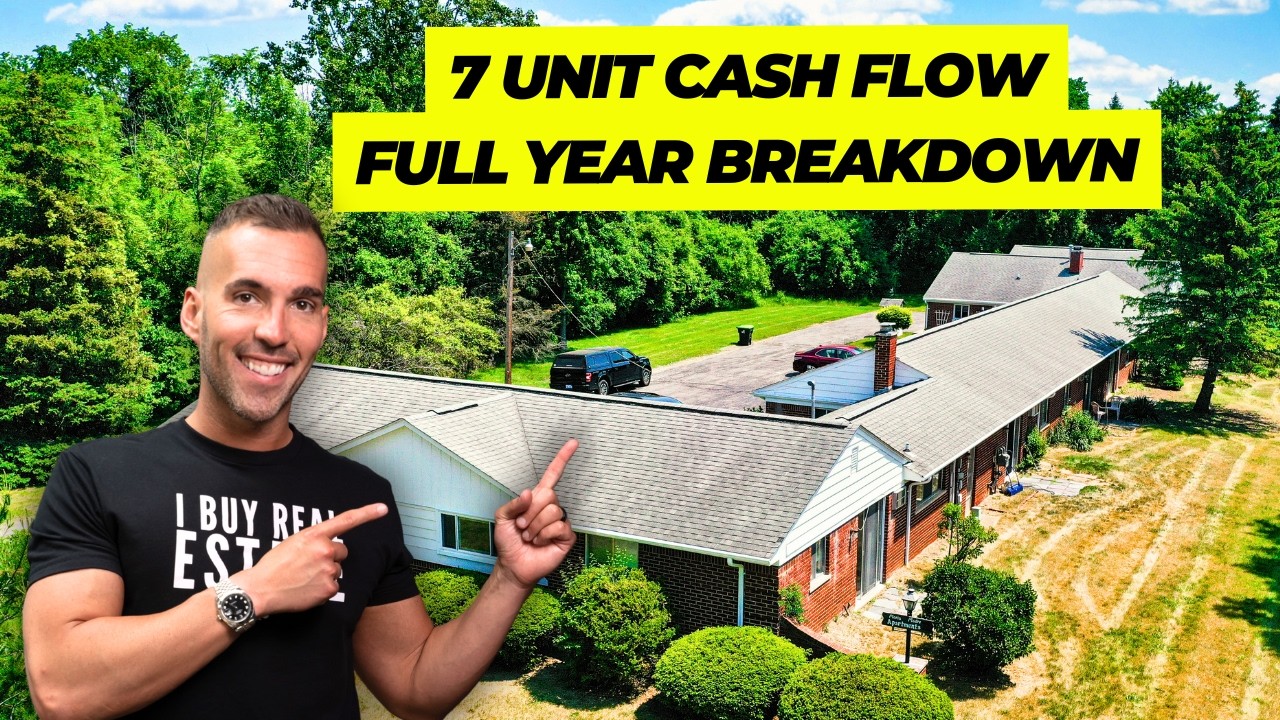
The BRRRR strategy on a small multifamily deal is how Andrea and I turned a $132,000 down payment into an infinite return on our first 7-unit apartment. We bought it right, improved it, forced the income up, refinanced, and pulled our original capital back out so we could repeat the process. In this post I’ll walk through the exact deal math from our real one-year P&L so you can see how BRRRR works on small multifamily, step by step — no hype, no exaggerated numbers, just the loop I run on every building I buy.
BRRRR in plain English
BRRRR stands for buy, rehab, rent, refinance, repeat. I run a small multifamily version where the emphasis is on forcing value, not heavy construction:
- Buy it right.
- Improve and rent it up — light value-add, not a gut rehab.
- Refinance once the income supports a higher value.
- Repeat by recycling the capital you pulled out.
The engine that makes the whole thing work is net operating income. On commercial-style multifamily, value is driven by NOI — not by what the neighbor’s house sold for. Drive NOI up and you drive the building’s value up. If you want the textbook version of the loop, BiggerPockets has a solid primer on the origin of the BRRRR method.
Step 1: Buy it right
I paid $660,000 for the 7-unit and put $132,000 down. When I bought it, rents were around $700 and the previous owners were leaving money on the table. That gap between current performance and realistic potential is the deal. You make your money on the buy.
Step 2: Improve and rent it up
This is where people overcomplicate it, so let me be clear: this was not a heavy construction play. As tenants moved out, I improved units, replaced beat-up appliances and floors, and brought them to market. Rents went from about $700 to roughly $1,100, and today they’re closer to $1,200. Light value-add, done as units turn, funded largely by the cash flow the building already produces. That’s the disciplined version of BRRRR.
Step 3: Force NOI up three ways
This is the heart of the strategy. There are three levers to push NOI on a small multifamily deal, and most investors only ever pull the first one.
1. Raise rents through improvements
Improve the unit, justify the rent, repeat at every turnover.
2. Add ancillary income
Rent is not your only income. On this 7-unit, gross rent was about $100,019, but total gross income was $115,487.93. That extra roughly $15,000 is money most investors leave on the table. Here’s where it came from:
- Barn rental: $7,000 for the year. There was an empty barn on the lot that the prior owner just stored junk in. I cleaned it out and leased it to someone storing classic cars.
- RUBS (ratio utility billback system): $3,485.47. I bill a fair portion of utilities back to tenants instead of eating 100% of the cost.
- Other income: late fees, application fees, notice fees, and damage chargebacks beyond security deposits.
3. Manage expenses
Every dollar you cut from controllable expenses flows straight to NOI — but don’t starve the asset. Take care of your property and it takes care of you.
The NOI-to-value math you need to understand
Here’s the formula that makes BRRRR work on multifamily:
Income − Expenses = NOI.
NOI ÷ Cap Rate = Value.
NOI excludes your mortgage payment (debt service). On this deal, I took NOI from about $30,000 to about $60,000 in the first year through value-add and ancillary income. At a 6% cap rate, that math looks like this:
$60,000 ÷ 0.06 = $1,000,000 in value.
I paid $660,000. By doubling NOI, I created roughly a million-dollar building. That’s forced appreciation, and it’s the whole reason BRRRR works on small multifamily. To run this math on your own deals, download my Multifamily Deal Analyzer.
Step 4: Refinance and recycle your capital
Once the building appraised at $1,000,000, I went back to the bank. They offered a 75% loan-to-value refinance:
- New loan (75% LTV): $750,000
- Old loan paid off: approximately $500,000
- Check to Andrea and me: approximately $250,000
That $250,000 came in tax-free, because it’s loan proceeds, not income — you don’t pay tax on borrowed money. (Confirm your specifics with a CPA, but cash-out refinance proceeds are generally not taxable because they’re debt.)
Now do the arithmetic. I invested $132,000. A year later I pulled out about $250,000 tax-free. My original equity left in the deal is zero. And the building still cash-flows. With no capital left invested, the return on a property that still produces cash is, mathematically, infinite.
Step 5: Repeat
That recycled capital goes into the next deal, and the loop starts again. Andrea and I have done six 100% cash-out refinances across our portfolio using this exact approach — you can read the breakdown of one of those refinances here. That’s how you compound without constantly raising fresh money.
How to analyze the deal: the cash flow chain
When you analyze a small multifamily property, follow this chain so you don’t fool yourself:
- Income − Expenses = NOI.
- NOI − Debt Service − CapEx = Net Cash Flow.
On this 7-unit in 2025, after a $53,343 mortgage and $7,723 of CapEx, net cash flow was $13,176. The cash flow is real, but as you can see, the bigger wins are the forced NOI, the equity created, and the tax-free capital you recycle. For a deeper walkthrough of my underwriting, read how I analyze multifamily properties.
Run your next deal through the numbers
If you want to apply BRRRR to your own small multifamily deal, start by underwriting NOI honestly and modeling the refinance. Download my Deal Analyzer to run the math, or apply for the mentorship if you want me to look at a deal with you. And if you’re brand new to this, start with small multifamily investing for beginners.
For the underlying valuation concepts, these are solid references: cap rate explained and net operating income.
Frequently Asked Questions
What does BRRRR stand for in multifamily investing?
BRRRR stands for buy, rehab, rent, refinance, repeat. On small multifamily I run a value-add version: buy the property right, improve units and rent them up, force net operating income higher, refinance once the higher income supports a higher value, then recycle the capital you pull out into your next deal so the same dollars keep working.
How do you force NOI up on a small multifamily property?
Three levers. First, raise rents through light improvements as units turn. Second, add ancillary income beyond rent, like my $7,000 barn lease and $3,485 in utility billbacks. Third, manage controllable expenses without starving the asset. On my 7-unit, I roughly doubled NOI from about $30,000 to $60,000 in a single year.
Is cash-out refinance money taxable?
Generally no, because cash-out refinance proceeds are borrowed money, not income, so they typically aren’t taxed. That’s how I received about $250,000 tax-free after refinancing my 7-unit. The tradeoff is a larger loan and higher debt service. Always confirm your specific situation with a qualified CPA before relying on this.
What cap rate should I use to value a multifamily deal?
Use the prevailing cap rate for comparable properties in your specific market, since it varies by area and asset quality. In my example the building was valued at a 6% cap rate, so $60,000 of NOI divided by 0.06 produced a $1,000,000 value. Lower cap rates mean higher values for the same NOI.
How long does one BRRRR cycle take on small multifamily?
On my deal I forced NOI up enough to refinance within roughly the first year, then repeated. Timelines vary with how fast units turn, how quickly you complete improvements, and lender seasoning requirements. The key is that you don’t move to the refinance step until the higher, stabilized income genuinely supports the new valuation.