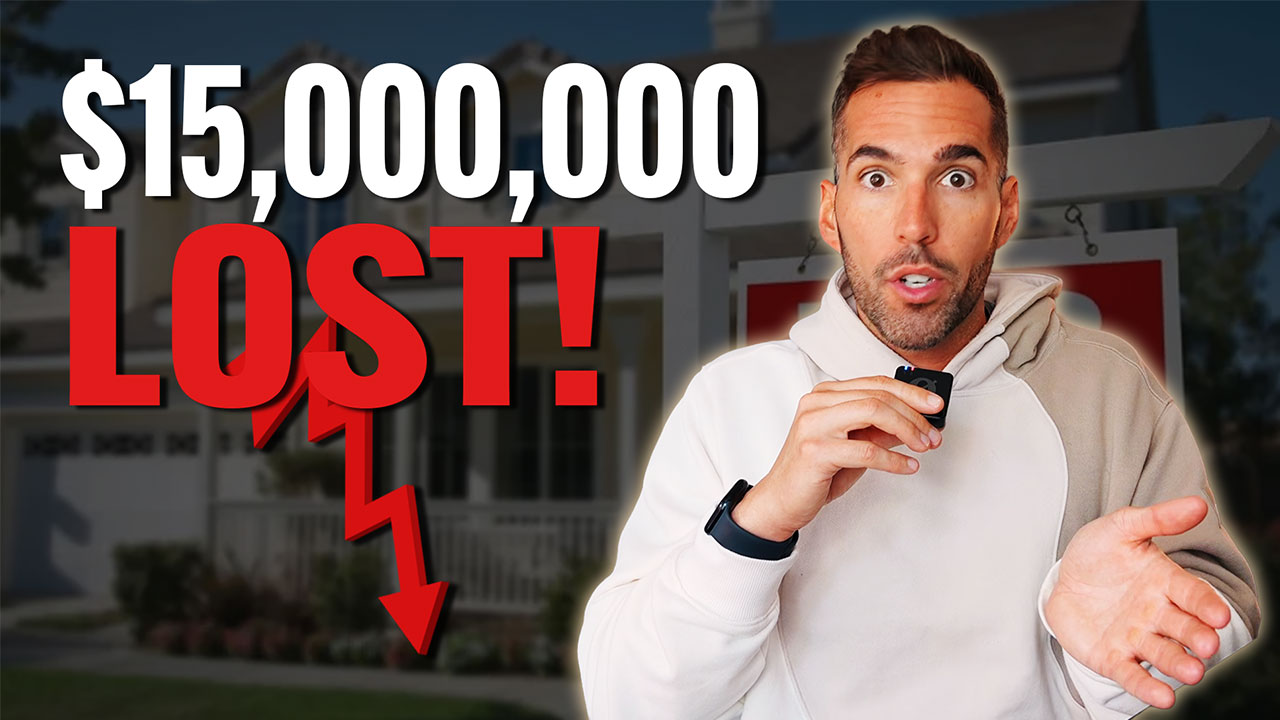
When I weigh small multifamily vs syndication, the gap has never been wider than it is right now. One of the most recognized names in real estate just publicly disclosed losing about $15 million of investor capital in a syndicated fund. I’m not here to pile on. I’m here to show you why private small multifamily real estate investing is winning while syndication is struggling, and why I’m grateful Andrea and I never raised a dollar.
This is the case for owning small and owning it yourself.
What happened: a $15M wake-up call
Brandon Turner — the former BiggerPockets podcast host and founder of Open Door Capital — publicly disclosed that investors in one of his syndicated deals lost their capital. By the account he shared in his own public statement, the loss ran to roughly $15 million, with the deal either handed back to the lender or sold at a loss. To his credit, he owned it publicly rather than going quiet.
I respect the transparency. But there’s a hard lesson here, and it isn’t unique to one person. A lot of syndicators are giving keys back and losing investor money right now.
How syndication works, and why it boomed
In a syndication, you raise money from many investors — usually accredited investors, meaning roughly a net worth over a million dollars — who sign private placement memorandums, or PPMs, acknowledging the risk. The sponsor often promises a preferred return to attract them, sometimes 8%, 10%, even 12%.
Syndication exploded in 2020 and 2021 for a specific reason: interest rates were historically low, and the post-COVID economy was flush with cash from stimulus, PPP, and SBA loans. It was the era of get-rich-quick, and the gurus were everywhere telling people to quit their jobs, raise money, buy apartments, hire third-party management, and kick their feet up.
The trap: floating-rate debt and recency bias
Here’s where it broke. Many syndicators used floating-rate debt tied to a benchmark like SOFR, and a lot of them skipped the rate cap that would have limited their exposure, because a cap costs money.
Then 2022 hit and rates climbed, and kept climbing. On floating-rate debt, a monthly payment could double or triple. A deal with $50,000 of monthly debt service could suddenly owe $75,000, and there’s no way to create $25,000 of new monthly income just to stay even — on top of the money you still need to reinvest in the property.
The whole thing was recency bias: rates were low, so surely they’d stay low. The mantra became “survive to 2025,” with everyone hoping rates would fall. They didn’t. We’ve sat in the 6–7% range since 2022.
When the music stops
So 2022 and 2023 passed, and by 2024 a lot of these operators were struggling. They owed money to banks, fell behind on mortgage payments, and still owed promised returns to investors. It’s a game of musical chairs, and when the song stopped, there was no chair left.
At that point you have two ugly exits. If the loan is non-recourse, you can hand the keys back to the lender, but you lose all of your investors’ money. Or you sell the building for less than you paid and take the loss. That’s how roughly $15 million of investor capital disappeared in the deal that kicked off this conversation.
Myth-busting small multifamily vs syndication
Myth: it’s passive income. The idea that you raise money, hire management, and kick your feet up is exactly what failed. Operators win. I respect the syndicator I know — Justin Brennan — who, when his deal got into trouble, flew across the country and lived on-site to protect his investors. Bragging about a ten-hour work week from a beach is a very different story when other people’s money is on the line.
Myth: “I own 5,000 doors.” It sounds great in a bio, but if you syndicated it, you might own a small slice of those doors while carrying the stress and headaches of all of them. I’d rather own a handful outright.
Myth: bigger means more freedom. Bigger means more reinvestment, more debt, more promises, and less control.
Why private small multifamily wins right now
Going private and small isn’t playing it safe for safety’s sake. It’s how you actually win in this market:
- You own 100% and don’t answer to anyone.
- You never promise a guaranteed or preferred return you can’t pay.
- You keep the full tax benefits — depreciation and 1031 exchanges — instead of splitting them across investors. Syndicators don’t get those benefits the way a private owner does.
- You can sit and wait. When a unit goes vacant, you can hold two or three months for the right tenant. A syndicator who guaranteed an 8–10–12% return often can’t, so they lower their standards, take weaker tenants, and bleed money through evictions.
- You use 10-year fixed-rate debt and plan to hold at least ten years, so rising rates don’t force your hand.
The 2026 capital-markets reality
There’s also a money-flow problem for syndication right now. With the stock market performing well, why would an investor hand you $100,000 for a 4% cash-on-cash return, locked up for five to ten years, when they can put it in an S&P 500 index fund doing around 20% year over year and stay liquid? That’s the wall built up against syndication in 2026, and it’s why I don’t know how anyone pencils a raise in this environment.
Is small multifamily worth it for you?
Honestly: yes, if you’re a high-income earner with real liquidity — at least $150,000 — and you’re willing to actually operate. No, if you want truly passive income or you’re chasing a no-money-down shortcut.
Remember the rule: you only lose in real estate if you run out of money or time. Private operators rarely run out of time, because it’s just you and your family making the calls. That’s the whole edge of small multifamily real estate investing over syndication.
It also comes down to temperament. I want a boring business and an exciting life, and small multifamily delivers exactly that — day to day, not much happens, which is precisely what you want when your money is on the line instead of a pool of investors’. The syndicator chasing a guaranteed return has to keep the machine fed; the private operator can wait. When a unit goes vacant, I can hold for the right tenant the way you’d hold out for the right customer, because the right tenant takes care of the building and pays on time. That patience is a luxury syndication rarely affords, and over a ten-year hold it’s the difference between winning and handing the keys back to the lender.
If you want to do what Andrea and I do — buy right, operate, refinance, repeat, without raising a dollar — book a call and look at the mentorship. And if you want the mechanics of how we actually grow a portfolio, read the small multifamily BRRRR method.
Frequently Asked Questions
Are multifamily syndications failing in 2026?
Many are struggling. Brandon Turner of Open Door Capital publicly disclosed losing around $15 million of investor capital, and he isn’t alone — operators are handing buildings back to lenders and selling at losses. The common thread is floating-rate debt that ballooned when rates rose, combined with promised returns they could no longer cover once the music stopped.
Is multifamily real estate passive income?
Not in my experience. The “raise money, hire management, kick your feet up” model is exactly what failed. The investors who protected their deals were the ones who showed up and operated, even living on-site when a deal got into trouble. Small multifamily done right is an active business — a wonderfully boring one — not a hands-off paycheck.
Small multifamily vs syndication — which is better for me?
If you have strong income and real liquidity and you’re willing to operate, owning small multifamily outright keeps you in full control, preserves your tax benefits, and lets you use safe fixed-rate debt. Syndication spreads ownership and tax benefits thin and can leave you exposed to a sponsor’s floating-rate debt and the returns they promised investors.
Why are high interest rates such a problem for syndicators?
Many used floating-rate debt without a rate cap. When rates climbed starting in 2022, monthly debt service could double or triple, and there’s no realistic way to generate that much new income overnight. Fixed-rate operators with long terms weren’t affected the same way, because rates only matter when you actually have to refinance.
Is small multifamily worth it in 2026?
It can be, if you’re a high-income earner with at least $150,000 liquid and you’re prepared to operate. With private ownership you can wait for the right tenant, keep your standards high, use 10-year fixed debt, and hold for the long term. It’s not passive and it’s not no-money-down, but it is controllable, which is exactly what syndication is not right now.